Wednesday, January 22, 2014

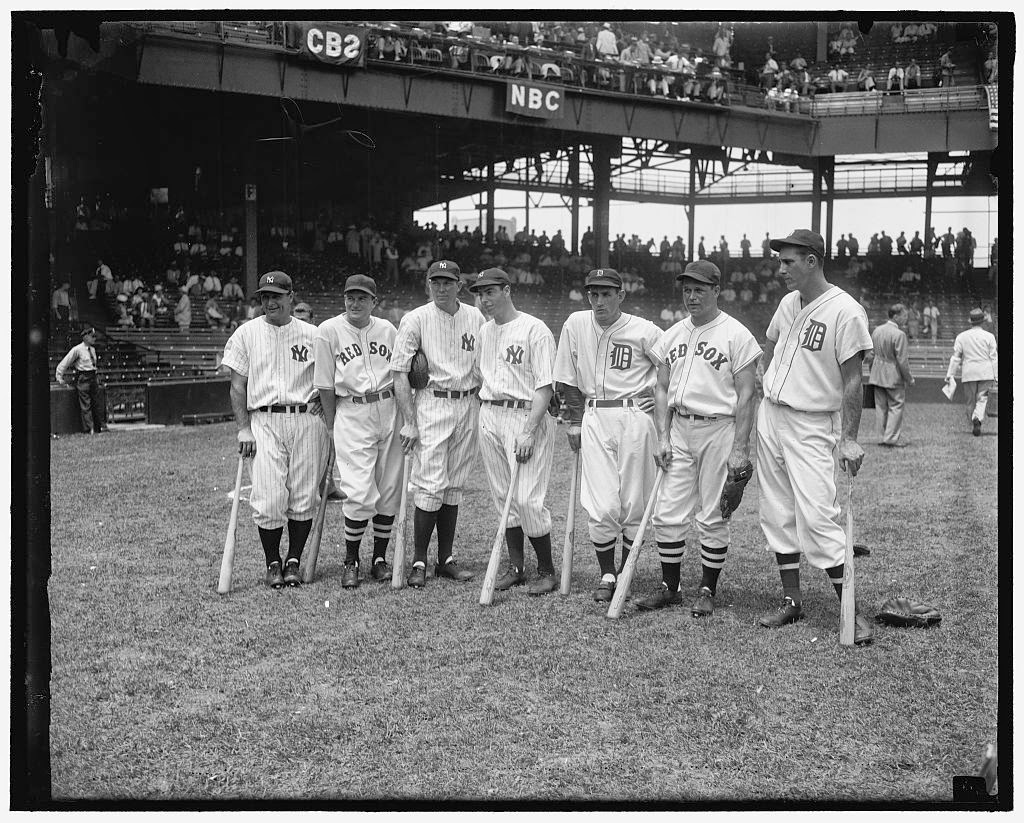
Historic Photos: 1937 AL All-Stars

Described in the original caption as "a million dollar baseball flesh," the seven All-Stars in this photo represented a combined million dollars in annual salary.  Today, you might be able to buy a utility infielder with a million dollars, but in 1937 it was enough for seven future Hall of Famers.

From left to right, they were: Lou Gehrig, Joe Cronin, Bill Dickey, Joe DiMaggio, Charlie Gehringer, Jimmie Foxx, and Hank Greenberg.  All seven would eventually be inducted into the Hall of Fame, and to this day are still among the all-time greats, even when compared to other Hall of Famers.  In his New Historical Baseball Abstract (2001), Bill James ranks Gehrig, Foxx, and Greenberg first, second, and eighth respectively in his list of the all-time greatest first basemen.  He also ranks Dickey seventh at catcher, Gehringer eighth at second base, Cronin eighth at shortstop, and DiMaggio fifth in center field.  In short, every single player in the photo ranks among the top ten all-time at their position, including three of the top ten first basemen.

Tuesday, January 21, 2014

Historic Photos: 1918 Boston Red Sox


The Red Sox were baseball's dominant team in the first couple decades of the 20th century; they won the first ever World Series in 1903, and would go on to win again in 1912, 1915, 1916, and finally in 1918. It meant out of 15 World Series, Boston won a third of them (there was no World Series in 1904, although Boston won the AL pennant that year). But, as any baseball fan is aware, it would be the last time the team would win in the 20th century. In many ways, this was the end of an era - in just over a year, pitcher Babe Ruth would be sold to the Yankees, which changed the way the game was played and marked the end of the Dead Ball Era.  In the meantime, though, the Red Sox were baseball's best team in 1918, and they beat the Chicago Cubs in six games.


Historic Photos: 1916 Boston Red Sox


The 1916 World Series champion Boston Red Sox, who defeated the Brooklyn Robins 4 games to 1; to this day, the 1915 and 1916 teams are the only Red Sox teams to win back-to-back World Series titles.

Photo courtesy of the Library of Congress.

Historic Photos: 1915 Boston Red Sox


The 1915 World Series champion Boston Red Sox; it was the second of four championships that the Red Sox would win between 1912 and 1918, when they beat the Phillies 4 games to 1.

Photo courtesy of the Library of Congress.

Historic Photos: 1912 Boston Red Sox

The 1912 World Series champion Boston Red Sox, taken shortly before the Series, in which they defeated the New York Giants in eight games (including one tie), culminating in a walk-off sacrifice fly by Larry Gardner.

The player identification, courtesy of the Library of Congress:

Top row (left to right): Joseph Quirk (trainer), Tris Speaker, unidentified girl, Joe Wood, Hick Cady, Pinch Thomas, Buck O'Brien, Hugh Bradley, Duffy Lewis. Middle row: Harry Hooper, Bill Carrigan, Steve Yerkes, Olaf Henriksen, Clyde Engle, Les Nunamaker, Charlie Hall, Larry Gardner, Ray Collins, Jake Stahl. Front row: Heinie Wagner, Hugh Bedient, mascot, Larry Pape, Marty Krug.

Photo courtesy of the Library of Congress.

Historic Photos: Babe Ruth and Teammates, c.1915-1917


Babe Ruth would eventually go on to become arguably the greatest player in baseball history, a right fielder who absolutely shattered the previous home run record, and whose single-season and career home run records stood for many years after his death.  However, in the mid 1910's, he was just another young pitcher on the Red Sox.  Here, he is seated alongside (left to right) fellow pitchers Ernie Shore and Rube Foster, and backup first baseman Del Gainer.  Like Ruth, Shore and Foster were effective pitchers who helped lead the Red Sox to back to back World Series titles in 1915 and 1916 - together, they accounted for 109 wins in those two seasons.  But, their pitching careers didn't last much longer.  Shore was ineffective after 1917 and out of the majors by 1920, and Foster was done after 1917.  Ruth's last season as a regular pitcher was in 1919, after which he was to the Yankees, with well-known ramifications for both teams.  As for Del Gainer on the far right, he was likewise done with baseball by the early 1920's.

Babe Ruth and Ernie Shore, when referred to together, are best known as having thrown one of the most unusual combined no-hitters in baseball history.  On June 23, 1917, Babe Ruth started against the Washington Senators.  He walked the first batter he faced, and then argued with the umpire over the calls.  After being ejected, he punched the umpire on his way out.  Shore came on in relief, the runner was caught stealing, and Shore pitched the remainder of the game without allowing a baserunner.

Incidentally, although their careers ended far sooner than Ruth's, Shore and Foster both outlived him by a significant margin - Ruth died in 1948 (a year after Del Gainer), but Shore died in 1980 at the age of 89, and Foster in 1976 at the age of 88.

Historic Photos: Calvin Coolidge, 1924 World Series


On October 4, 1924, President Calvin Coolidge threw out the first ball of the 1924 World Series between the Washington Senators and the New York Giants.  The series would end up as one of the most memorable in World Series history, with Washington tying the score in the bottom of the 8th inning of Game 7 thanks to a 2-out, bases loaded ground ball that took a bad hop over third baseman Freddy Lindstrom.  Washington would go on to win it in the 12th inning behind the relief pitching of Walter Johnson, with the winning hit coming on another ground ball that took a bad hop on Lindstrom (Giants players named Fred seem to have problems fielding the ball in extra innings in the final game of the World Series. See Snodgrass, Fred). In the end, though, Walter Johnson, possibly the greatest pitcher in baseball history, finally had his first and only World Series title.  Things would also end well for Calvin Coolidge - exactly a month after this photo was taken, he was re-elected in a landslide.

Photo courtesy of the Library of Congress.

Historic Photos: Mayor John F. Fitzgerald, c.1910


John F. Fitzgerald was an avid Red Sox fan; he was a member of the Royal Rooters fan club in the early 1900s, and served as mayor of Boston from 1906 to 1908 and 1910 to 1914.  At some point during his second term, he threw out the first ball at Huntington Avenue Grounds.  Several years later, in 1912, he would throw out the first ball at the opening day of Fenway Park.  Fitzgerald died in 1950, and ten years later, his grandson, John Fitzgerald Kennedy, was elected President of the United States.

Photo courtesy of Boston Public Library.

Historic Photos: 1905 Philadelphia Athletics


The Philadelphia Athletics were one of the original American League franchises in 1901, with Connie Mack (center, with suit) as the manager.  Four years later, Mack led the A's to their first World Series appearance, where this photo was taken, at the New York Giants' Polo Grounds.  The A's lost 4-1, but Mack was just getting started - he would lead his team to five World Series championships during his unprecedented 50 years as their manager.  He finally retired after the 1950 season at the age of 87, and five years later the team moved to Kansas City, and later to Oakland.  Connie Mack died in 1956, having accumulated 3,731 managerial wins - nearly 1,000 more than second place John McGraw, who defeated Connie Mack in the 1905 World Series.

Player identification, courtesy of Boston Public Library:

Standing, left to right: George Hall. Athletics, George Bechtel, Athletics, William Craven, Athletics, Adrian "Baby" Anson, Athletics, Ezra Sutton, Athletics, John E. Clapp, Athletics, Jim White, Red Stockings, Al Spalding, Red Stockings, George Wright, Red Stockings, Cal McVey, Red Stockings, Harry Wright, Red Stockings. Seated: Weston Fisler, Athletics, David Force, Athletics, David Eggler, Athletics, Dick McBride, Athletics, Andy Leonard, Red Stockings, Jim O'Rourke, Red Stockings, Ross Barnes, Red Stockings, Harry C. Schafer, Red Stockings.

Photo courtesy of Boston Public Library.

Historic Photos: 1875 Boston Red Stockings and Philadelphia Athletics


Taken at Boston's South End Grounds, this photo shows the top two teams of the National Association in their last year of existence: Boston finished 15 games ahead of the Athletics with a 71-8 record.  The league operated from 1871 to 1876, with the Red Stockings winning the pennant every year except 1871.

The National Association was the first professional baseball league, but its status as a major league is highly questionable - it represented the highest level of competition at the time, but the beginning of Major League Baseball as we know it today is generally considered to be 1876, when the NA folded and was replaced by the National League.  Both Boston and Philadelphia joined the NL for the 1876 season; the Red Stockings later became the Beaneaters and, eventually, the Braves, and are the same franchise that many years later would move to Atlanta by way of Milwaukee.  The Athletics, on the other hand, were expelled from the National League partway through the 1876 season, and are not associated with the modern-day Athletics team, which began play as Philadelphia's American League franchise in 1901.

Player identifications, courtesy of Boston Public Library:

Standing, left to right: George Hall. Athletics, George Bechtel, Athletics, William Craven, Athletics, Adrian "Baby" Anson, Athletics, Ezra Sutton, Athletics, John E. Clapp, Athletics, Jim White, Red Stockings, Al Spalding, Red Stockings, George Wright, Red Stockings, Cal McVey, Red Stockings, Harry Wright, Red Stockings. Seated: Weston Fisler, Athletics, David Force, Athletics, David Eggler, Athletics, Dick McBride, Athletics, Andy Leonard, Red Stockings, Jim O'Rourke, Red Stockings, Ross Barnes, Red Stockings, Harry C. Schafer, Red Stockings.

Photo courtesy of Boston Public Library.

Historic Photos: 1900 Boston Beaneaters


The Boston Beaneaters were a dominant team in the National League throughout the 19th century, and from 1892 to 1898 they finished in first place four times in seven years, in what was at the time a 12-team league. The 1900 team, seen in this photo, didn't quite live up to their potential, finishing in fourth place with a 66-72 record, despite having a Hall of Fame manager and five Hall of Fame players on the roster.

In many ways, this photo represents the end of an era - the last year of the 19th century also marked the last year that the National League existed unopposed.  In 1901, the American League would declare major league status, and Boston's AL franchise would take away many of the Beaneaters' star players.  Hall of Fame third baseman Jimmy Collins (bottom row, far right); outfielders Buck Freeman (middle row, second from left) and Chick Stahl (top row, middle); and pitchers Nig Cuppy (middle row, far left), Ted Lewis (middle row, far right), and Bill Dinneen (middle row, third from right) all left to join the future Red Sox.

In addition to those who left to join the American League, other notable players in this picture include Hall of Famers Hugh Duffy (top row, second from right), Billy Hamilton (bottom row, second from left), Kid Nichols (bottom row, third from left), and Vic Willis (middle row, second from right), along with Hall of Fame manager Frank Selee (bottom row, center).  Backup catcher Jack Clements (bottom row, far right) played his last of 17 major league seasons in 1900; to this day he remains the only left-handed catcher to play any significant amount of time in the majors.

The complete player identification, courtesy of Boston Public Library:

Top, left to right: Bobby Lowe, second baseman, Shad Barry, Chick Stahl, outfielder, Hugh Duffy, outfielder, Boileryard Clarke. Middle row: Nig Cuppy, Buck Freeman, outfielder, Billy Sullivan, Bill Dineen, pitcher, Vic Willis, Ted Lewis, pitcher. Bottom row: Jack Clements, Billy Hamilton, outfielder, Kid Nichols, pitcher, Frank Selee, Manager, Herman Long, shortstop, Fred Tenney, first baseman, Jimmie Collins, third baseman.

Photo courtesy of Boston Public Library.

Historic Photos: 1911 Huntington Avenue Grounds


These two photos aren't quite as well known as the famous one from the 1903 World Series, but these were taken during an actual game, in 1911, its 11th and final year in existence.  It was the original home of the Red Sox, and was where they won their first World Series, in 1903, and was replaced after the 1911 season by Fenway Park, just a short distance away.

Aside from the baseball element of the photo, I also find the advertisements on the walls to be interesting. There are long-lost beverages with such unappetizing names as Pureoxia Ginger Ale and Dr. Swett's Original Root Beer, questionable products such as Old Grist Mill Dog Bread, and defunct breweries like Harvard Brewing Company.  One company that survived a while, though, has an ad barely visible just to the right of the centerfield flagpole - Narragansett Brewing Company, which would remain a Red Sox sponsor well into the 1960s.

Photo courtesy of Boston Public Library.

Monday, January 20, 2014

Historic Photos: 1903 World Series


Taken at Boston's Huntington Avenue Grounds, this photo shows the two teams that competed in the first World Series: the Boston Americans and the Pittsburgh Pirates.  It was a best of 9 series, which Boston won in 8 games.

The players, according to the description provided by the Boston Public Library, are as follows:

The Pirates: (Top, left to right)- second baseman Claude Ritchey, catcher Harry Smith, catcher Eddie Phelps, outfielder Ginger Beaumont, pitcher Deacon Phillippe, pitcher Sam Leever, pitcher Bucky Veil, pitcher Gus Thompson, outfielder Tommy Leach, outfielder Jimmy Sebring, pitcher Brickyard Kennedy, catcher Fred Carisch and shortstop Honus Wagner. Middle: Pirate manager and outfielder Fred Clarke. Boston players: third baseman-manager Jimmie Collins, outfielder Chick Stahl, pitcher Bill Dineen, outfielder Buck Freeman, pitcher Cy Young, first baseman Candy LaChance, outfielder Patsy Dougherty, pitcher George Winter, catcher Duke Farrell, outfielder Jack O'Brien, pitcher Long Tom Hughes. Bottom: shortstop Fred Parent, catcher Lou Criger, second baseman Hobe Ferris.

Photo courtesy of the Boston Public Library

Historic Photos: 1901 Boston Americans


This is the first of what I hope will be a series of posts highlighting historic images from baseball's past.  Every so often, I come across a photo that I find interesting or intriguing, so I figured this would be a good opportunity to share some of them.  All of the photos that I post are either in the public domain, or are reproduced under non-commercial licenses.

This particular photo is the team photo from the 1901 Boston Americans (later known as the Red Sox).  It was the first year of the team's storied existence.  They were established to compete with the extraordinarily successful National League Boston Beaneaters team, and almost immediately they became a fan favorite in Boston.  Much of this had to do with the team's talent - Cy Young (third from left in the middle row) went 33-10 to win the Pitching Triple Crown, first baseman Buck Freeman (middle, top row) finished second in the league with 12 home runs, and third baseman/manager/future Hall of Famer Jimmy Collins (middle, front row, with arms crossed), recruited from the Beaneaters, would have an excellent season as well.

The names of all of the players in the photo:

Top row, Left to right: Kit McKenna, Buck Freeman,Charlie Hemphill. Second row: Fred Parent, George Cuppy, Cy Young, Abrose Kane, Tommy Dowd, Chick Stahl. Third row, seated: Hobe Ferris, Lou Criger, catcher, Jimmie Collins, Ossie Schreckengost, Fred Mitchell. Front: Larry McLean, first baseman.

Photo courtesy of Boston Public Library

Thursday, October 24, 2013

Past World Series Results

Exactly how good of a chance does a team have of winning the World Series if they win Game 1?  In recognition of the Red Sox winning last night, I decided to take a look at past winners and find out.  For the purposes of this, I have excluded the four World Series that were played in a best-of-nine format, so that everything is consistent.  So, here are the World Series win-loss records, and winning percentages, of teams that have:
  • Won Game 1:                              66-38 (63%)
  • Won Games 1 & 2:                      41-10 (80%)
  • Won Games 1, 2, and 3:              24-0 (100%)
  • Won Game 1, lost Game 2:          25-28 (47%)
  • Won Games 1 & 2, lost Game 3:  17-10 (63%)
  • Lead 2 games to 1 after 3:            54-26 (68%)
  • Lead 3 games to 2 after 5:            40-19 (68%)

Thursday, August 8, 2013

Earliest MLB Debuts

Quick question: Which active MLB player had the earliest debut game? Mariano Rivera? Derek Jeter? Jason Giambi?  They're close, but the player who beats them out by a matter of weeks is LaTroy Hawkins, presently of the Mets and formerly of the Angels, Brewers, Astros, Yankees, Rockies, Orioles, Giants, Cubs, and Twins.  He made his MLB debut on April 29, 1995, a mere 9 days before the runner-up, Mariano Rivera.

Now, 1995 seems like it wasn't all that long ago, especially when considering that last year's leader, Jamie Moyer, first started playing in the majors in 1986.  So, I decided to take a look at, historically, who among active layers in each season had the earliest debuts.  As my discoveries showed, it is in fact unusual to have no active players from 20 years ago or earlier - in fact, unless someone like Jamie Moyer or Omar Vizquel makes another appearance before the end of this year, it will be the first time since 1969 that the longest-active player debuted 18 years prior.  The leader in that season? Willie Mays, who debuted in 1951.

So, I have included the list, showing which player in each season had the earliest debut, going back to 1894. Note that I am not counting the National Association (1871-1875) as a major league, so players such as Jim O'Rourke and Cap Anson are listed here as having their MLB debuts in 1876, rather than basing it on their first year in the NA.

Year Player Debut Year
2013 LaTroy Hawkins 1995
2012 Jamie Moyer 1986
2011 Omar Vizquel 1989
2010 Jamie Moyer 1986
2009 Jamie Moyer 1986
2008 Jamie Moyer 1986
2007 Julio Franco 1982
2006 Julio Franco 1982
2005 Julio Franco 1982
2004 Julio Franco 1982
2003 Jesse Orosco 1979
2002 Mike Morgan 1978
2001 Mike Morgan 1978
2000 Mike Morgan 1978
1999 Mike Morgan 1978
1998 Dennis Eckersley 1975
1997 Dennis Eckersley 1975
1996 Dennis Eckersley 1975
1995 Dave Winfield 1973
1994 Charlie Hough 1970
1993 Nolan Ryan 1966
1992 Nolan Ryan 1966
1991 Nolan Ryan 1966
1990 Nolan Ryan 1966
1989 Tommy John 1963
1988 Tommy John 1963
1987 Tommy John 1963
1986 Pete Rose 1963
1985 Pete Rose 1963
1984 Pete Rose 1963
1983 Jim Kaat 1959
1982 Jim Kaat 1959
1981 Jim Kaat 1959
1980 Minnie Minoso 1949
1979 Willie McCovey 1959
1978 Ron Fairly 1958
1977 Brooks Robinson 1955
1976 Minnie Minoso 1949
1975 Hank Aaron 1954
1974 Hank Aaron 1954
1973 Willie Mays 1951
1972 Willie Mays 1951
1971 Willie Mays 1951
1970 Willie Mays 1951
1969 Willie Mays 1951
1968 Mickey Mantle 1951
1967 Curt Simmons 1947
1966 Joe Nuxhall 1944
1965 Warren Spahn 1942
1964 Warren Spahn 1942
1963 Early Wynn 1939
1962 Early Wynn 1939
1961 Early Wynn 1939
1960 Ted Williams 1939
1959 Ted Williams 1939
1958 Ted Williams 1939
1957 Enos Slaughter 1938
1956 Bob Feller 1936
1955 Phil Cavarretta 1934
1954 Phil Cavarretta 1934
1953 Phil Cavarretta 1934
1952 Bobo Newsom 1929
1951 Dutch Leonard 1933
1950 Dutch Leonard 1933
1949 Luke Appling 1930
1948 Earl Caldwell 1928
1947 Red Ruffing 1924
1946 Ted Lyons 1923
1945 Paul Schreiber 1922
1944 Johnny Cooney 1921
1943 Johnny Cooney 1921
1942 Johnny Cooney 1921
1941 Johnny Cooney 1921
1940 Johnny Cooney 1921
1939 Jimmie Dykes 1918
1938 Jimmie Dykes 1918
1937 Rogers Hornsby 1915
1936 Rogers Hornsby 1915
1935 Rabbit Maranville 1912
1934 Charley O'Leary 1904
1933 Nick Altrock 1898
1932 Jack Quinn 1909
1931 Nick Altrock 1898
1930 Eddie Collins 1906
1929 Nick Altrock 1898
1928 Ty Cobb 1905
1927 Ty Cobb 1905
1926 Ty Cobb 1905
1925 Chief Bender 1903
1924 Nick Altrock 1898
1923 Fred Carisch 1903
1922 Johnny Evers 1902
1921 Kaiser Wilhelm 1903
1920 George McBride 1901
1919 Nick Altrock 1898
1918 Hughie Jennings 1891
1917 Bobby Wallace 1894
1916 Bobby Wallace 1894
1915 Fred Clarke 1894
1914 Clark Griffith 1891
1913 Jack Ryan 1889
1912 Deacon McGuire 1884
1911 Cy Young 1890
1910 Deacon McGuire 1884
1909 Arlie Latham 1880
1908 Deacon McGuire 1884
1907 Deacon McGuire 1884
1906 Deacon McGuire 1884
1905 Deacon McGuire 1884
1904 Jim O'Rourke 1876
1903 Deacon McGuire 1884
1902 Frank Foreman 1884
1901 Joe Quinn 1884
1900 Jack Clements 1884
1899 Arlie Latham 1880
1898 Bid McPhee 1882
1897 Cap Anson 1876
1896 Cap Anson 1876
1895 Cap Anson 1876
1894 Cap Anson 1876

Wednesday, July 17, 2013

The Greatest Games Ever Pitched (and lost)

Wins are a fickle thing for pitchers.  They are one of the most commonly-cited measures of a pitcher's ability, and leading the league in wins is part of the Pitching Triple Crown.  Cy Young Award winners almost always have high win totals, which isn't surprising, considering the award is named after the greatest winner in baseball history.  However, what do wins really tell us? Obviously, there are 9+ players contributing to the team's effort, so it's not just the pitcher who has a say in the outcome of the game.  As a result, there are bound to be imbalances: a pitcher can allow 9 runs in 5 innings one day and earn the win, and then in his next start lose a 1-0 one-hitter.  These tend to balance out over time, but it makes for some curious individual games.  What I have done below is list the top 10 greatest games ever pitched by a losing pitcher.  A few are well-known, others aren't - some were pitched by Hall of Famers, and some by relatively unknown journeymen.  Either way though, they represent 10 of the greatest pitching efforts that, in the end, went all for naught.

#10: Ted Lyons, May 25, 1929. 21 IP, 24 H, 6 R, 6 ER, 2 BB, 4 K

Normally, 24 hits and 6 runs doesn't exactly scream "great pitching performance," but it's not too bad when spread out over 21 innings.  In this matchup between the Tigers and White Sox at Comiskey Park, two great pitchers faced off: George Uhle for Detroit and future Hall of Famer Ted Lyons for Chicago.  The White Sox started out with 2 in the first inning, but the Tigers took the lead right after that, scoring 3 in the second and 1 in the third.  The White Sox responded with 3 in the fifth, before the Tigers tied it up in the top of the seventh, at 5-5.  I'm sure none of the spectators saw this as a great pitcher's duel, but after the seventh, that's what it turned into.  Both pitchers went on to pitch 13 shutout innings, before the Tigers finally scored a run in the top of the 21st.  Detroit then brought on a relief pitcher with the unfortunate name of Lil Stoner to close out the game, and handed Ted Lyons a loss in one of the best-pitched games of his career.  Sure, he got of to a rocky start, but those 13 consecutive shutout innings have to say something.  Still, there were nine other pitchers who managed to do even better, and still lose.

#9: Al Jackson, August 14, 1962. 15 IP, 6 H, 3 R, 2 ER, 5 BB, 6 K

This involves the 1962 Mets, so you know it's not going to end well for their pitcher.  Jackson lost 20 games with the Mets in 1962, but this was probably the toughest of those losses.  Facing Dallas Green of the Phillies, the Mets took a 1-0 lead in the bottom of the third, but didn't score again until the seventh inning...of their next game.  The Phillies, on the other hand, tied the game in the fifth, but then their bats got quiet for a while.  They switched pitchers twice, with the eventual winning pitcher, Jack Baldschun, throwing a paltry 4.1 innings compared to Jackson's effort.  Jackson scattered just six hits throughout his 15 innings, although two in the top of the 15th, plus a catching error at first base, allowed the Phillies to finally take the lead.

#8: Kevin Appier, July 27, 1993. 9 IP, 1 H, 1 R, 1 ER, 1 BB, 11 K

Although not quite at the same level as a no-hitter, a complete game one-hitter is still a fairly significant pitching performance, and almost a guaranteed win, especially when the pitcher also allows just one other baserunner - a walk to a batter who is then thrown out trying to seal second base.  However, for Kevin Appier of the Royals, allowing just one hit wasn't enough - that one hit happened to be a home run to Texas's Rafael Palmeiro.  The Royals, although collecting 9 hits off Kenny Rogers, were unable to score a run, and the victory went to the aforementioned Rogers instead, despite a stellar one-hitter on Appier's part.

#7: Carl Hubbell, April 29, 1936. 16.1 IP, 11 H, 2 R, 1 ER, 4 BB, 6 K

 Carl Hubbell was in his prime in 1936, winning the MVP Award, not to mention this blog's Retroactive NL Cy Young Award, and one of his best pitching performances was this game.  Going up against the Cardinal's good but unspectacular Roy Parmelee, future Hall of Famer Hubbell matched him for the first 9 innings, with neither starter allowing a run.  This double shutout continued until the 12th, when Hubbell's Giants finally scored a run.  Their lead didn't last long, though, because Hubbell promptly gave up a run to the Cardinals in the bottom of the inning.  Thus tied 1-1, the stalemate continued until the bottom of the 16th, when the Cardinals finally won the game 2-1.  One of their runs was unearned, but the box score is unclear about who was responsible for that error, or which run was unearned.

#6: Warren Spahn, July 2, 1963. 15.1 IP, 9 H, 1 R, 1 ER, 1 BB, 2 K

Warren Spahn was no stranger to tough losses - despite winning more games than any post-1920 pitcher, he also had his share of losses that he should've won.  of the 60 or so games that I came up with on my initial list, three of those were lost by Spahn.  However, none were quite as heartbreaking as this tough loss to the Giants.  It was certainly a pitching matchup that lived up to its billing of two future Hall of Famers: 42 year old Warren Spahn of the Braves, against 25 year old Juan Marichal of the Giants, at San Francisco.  The lineups were equally impressive.  Not counting the pitchers, the Braves had two future Hall of Famers in their lineup: Hank Aaron and Eddie Mathews.  The Giants countered with Willie Mays, Willie McCovey, and Orlando Cepeda, for a total of seven Hall of Famers between the two teams.  Despite these impressive batters, though, they could do nothing against either the young pitcher or the aging veteran.  For the first 15 innings, neither team scored a run.  In the top of the 16th, Marichal shut out the Braves again, but in the bottom of the innin, Spahn finally cracked.  He got Harvey Kuenn to fly out to center, but the next batter was Willie Mays.  Mays's hit his first home run off of Spahn, in 1951, and 12 years later he hit number 383 to win the game for the Giants.

#5: Andy Hassler, September 8, 1974. 9 IP, 1 H, 1 R, 0 ER,  3 BB, 6 K

Not many pitchers can have a game ERA of 0.00 and still lose, but that's what happened to the Angels' Andy Hassler against the White Sox.  It was a rough season for Hassler when it came to wins: he was 7-11, despite a very respectable 2.61 ERA.  And none of those seven wins were quite as good as his one-hitter that allowed zero earned runs.  Unfortunately, his own team couldn't pick up any runs against either Jim Kaat or Terry Forster, as the one hit that Hassler allowed - a double to Lee Richard in the third - resulted in a run when third baseman Dave Chalk made an error on a ground ball that could've otherwise been an inning-ending double play.

#4: Bob Smith, May 17, 1927. 22 IP, 20 H, 4 R, 3 ER, 9 BB, 5 K

This game, although not a record for either the longest game or the most innings pitched by one pitcher, is notable in that Smith's 22 innings pitched are the most in post-1920 baseball for a losing pitcher.  Smith, pitching for the Boston Braves in Boston, allowed the Cubs to take a 3-0 lead by the fifth inning.  However, the Braves got to Chicago starter Sheriff Blake in the sixth and seventh, and the Cubs went to their bullpen in the eighth.  They then turned to Bob Osborn in the ninth, who pitched 14 scoreless innings to pick up the win.  But, Bob Smith went the distance for the Braves, pitching all 22 innings before finally allowing a 4th run to Chicago.  All in all, it must've been a frustrating day for Smith, who pitched the equivalent of 2.5 complete games, only to be rewarded with the loss.

#3: Dick Fowler, June 5, 1942. 16 IP, 9 H, 1 R, 1 ER, 5 BB, 6 K

Speaking of post-1920 records, Dick Fowler holds the record for most innings pitched by a losing pitcher who only allowed one run. (Isn't baseball amazing when we can identify the holders of such obscure records?)  In any case, Fowler, pitching for the Philadelphia Athletics, was up against the St. Louis Browns.  The Browns, for once in their existence, weren't bad in the World War II years, primarily because most of the able-bodied players were in the military, which meant St. Louis's roster stayed pretty much intact.  But, Fowler wasn't too bad in this game either, and he and St. Louis starter Johnny Niggeling both went a full 9 innings without allowing a run.  This continued into extra innings, but Niggeling was done after the 12th.  He was replaced by George Caster, but Fowler kept pitching until the top of the 16th, when Browns centerfielder Wally Judnich tripled and was driven in by Chet Laabs.  So, Fowler ended up with a loss, despite a game ERA of 0.56.  He would go on to have a 6-11 record on the year, before enlisting in the Canadian Army.  Interestingly, despite missing out on a shutout in this game, he would eventually get his revenge on the Browns when he returned from the war.  In his first start since before the war, he pitched a 1-0 no-hitter against the Browns in St. Louis.  It was his first career shutout, and to this day the only MLB no-hitter pitched by a Canadian.

#2: Ken Johnson, April 23, 1964. 9 IP, 0 H, 1 R, 0 ER, 2 BB, 9 K

There have been 281 official no-hitters in Major League history.  Of those, 271 were complete games, and of the complete games, 270 were won by the pitcher.  The one remaining no-hitter, of course, belonged to Ken Johnson.  It's not uncommon for no-hitters to not be shutouts, as there are six other ways for batters to reach base aside from a hit.  However, for a pitcher to actually lose the game is, obviously, rare.  In this particular game, Johnson's Astros faced Joe Nuxhall of the Cincinnati Reds.  Both pitchers pitched well, with neither team scoring a run until the top of the ninth.  It started off easy enough, with Nuxhall grounding out to third, but the next batter, the previous year's Rookie of the Year, Pete Rose, reached on an error by Johnson.  He made it to second on the error, and then advanced to third on a groundout (the play-by-play indicates that it was a 1-5-3 (pitcher to third base to first base) putout, but I'm not entirely sure how that actually played out.  My guess is the ball glanced off Johnson before the third baseman picked it up.  Either way, the next batter, Vada Pinson, reached on an error by, of all people, the Gold Glove Award-winning second baseman Nellie Fox, which allowed Rose to score.  The Astros could do nothing in the bottom of the ninth, and Johnson simultaneously earned the no-hitter and the loss.  It would easily be the greatest game ever pitched and lost, if not for an even more heartbreaking loss just five years earlier.

#1: Harvey Haddix, May 26, 1959.  12.2 IP, 1 H, 1 R, 0 ER, 1 BB, 8 K

This is the one game on this list that doesn't need the qualifier "and lost" to be considered the greatest game ever pitched.  There is simply little doubt that what Pirates pitcher Harvey Haddix did in this game ranks among the most impressive pitching performances ever.  Certainly, a perfect game is the ultimate sign of pitching performance.  It's hard to get better than retiring every single batter you face.  However, every "official" perfect game pitcher has faced, and retired, exactly 27 batters.  No official perfect game has ever gone into extra innings.  In this game, Haddix was perfect through nine innings, but Braves starter Lew Burdette was almost as good, allowing no runs either.  So, the game continued into extra innings, with the two time defending NL champion Braves still unable to get a baserunner off of Haddix.  However after 12 perfect innings, 3 more than any other pitcher in MLB history, the Braves finally reached base in the bottom of the 13th on an error by third baseman Don Hoak.  The batter, Felix Mantilla, reached second on a bunt by Eddie Mathews, and the next batter, Hank Aaron, was understandably intentionally walked.  The no-hitter was still intact, until the next batter, Joe Adcock, hit a home run.  Well, sort of a home run.  It left the playing field, but this is where it gets bizarre, because Hank Aaron left the basepaths, and Adcock passed him on his way around the bases.  As a result, Adcock was considered out, and since the last base he legally reached was second, it only counted as a double.  Mantilla scored regardless, which won the game, but because it was no longer a home run, Hank Aaron's run didn't count (if it's not a home run, the only runs that officially count are the ones needed to win the game), which meant instead of allowing 1 unearned run and 2 earned runs, Haddix officially allowed just one unearned run.  But, a loss is a loss, and especially after pitching 12 perfect innings, is tough no matter how many or few runs you're ultimately charged with.

Saturday, December 22, 2012

Red Sox sign veteran SS Clarence "Ace" Parker

In an offseason characterized by overpaying mediocre, aging players, the Red Sox have finally pulled off the blockbuster deal that Boston fans have been longing for all winter.  General Manager Ben Cherington announced today that veteran A's shortstop Clarence "Ace" Parker has agreed to a 2-year, $14.5 million deal, which some team officials are already calling a "bargain."  Although Parker, 100, has not played in the majors since 1938, Cherington believes "he brings a significant veteran presence to the clubhouse," and "he has demonstrated a remarkable athletic talent."  Parker, after a 2-year career as a utility infielder for the A's, left baseball to pursue a career in the NFL.  He found his niche there, playing for the Brooklyn Dodgers as a quarterback/running back/defensive back/kicker/punter/kick returner/punt returner before being elected to the Pro Football Hall of Fame in 1972. 

However, Cherington feels that Parker is "ready to make the transition back to baseball," emphasizing that he is "a significant upgrade in shortstops," referring to the recent signing of Stephen Drew, 29, coincidentally also a former A's shortstop.  "We're exploring trading options for Drew," a team source said under the condition of anonymity.  "Parker represents a significant upgrade in many areas, especially when it comes to injuries.  He has outlived all of his other teammates, so if that doesn't say he can stay healthy, I don't know what does."

Cherington also deflected criticism over Parker's salary, explaining that although his $7.25 million annual salary is nearly five thousand times that of his 1938 salary of $1,500, "It's long overdue that he be adequately paid for his past successes, and we at the Red Sox are always happy to be the ones to do that."

The team source also indicated that Cherington was attempting to coax former Red Sox second baseman Bobby Doerr out of retirement.  Doerr, 94, is the only living former opponent of Parker, and is expected to compete with Dustin Pedroia in spring training for the starting role.

Thursday, October 4, 2012

Cy Young Predictor

So apparently ESPN has a Cy Young prediction formula, and using that formula it is possibly to objectively determine the most likely winner of the Cy Young Award for the years before the award existed. So naturally, I decided to check my own choices for Cy Young Award winners from 1876-1955.  The results were that, of 149 award winners that I selected, 105 of them matched up with the Cy Young predictor, meaning that 70% of my choices can be objectively verified.  Of course, I don't know exactly what criteria goes into the predictions, but overall I'd say not bad.

Friday, September 14, 2012

Worst Red Sox Team Ever

Today, Red Sox manager Bobby Valentine remarked that the Red Sox currently have the weakest roster in team history.  Given their thoroughly underwhelming 64-80 record, they are certainly the worst Red Sox team in recent history.  In fact, their .444 winning percentage is worse than any Red Sox team since 1966, when they had the same percentage.  However, do they actually have a chance at being the worst Red Sox team ever?

Actually, they won't even break the top ten.

Provided the Red Sox win one more of their remaining 18 games (admittedly a difficult challenge for this team), they can rest assured knowing they will be guaranteed to finish above .400 (someone forgot to tell them that hitting .400 doesn't mean reaching it in the standings).  This will put them ahead of 11 other Red Sox teams, mostly from the 1920s, that reached even lower points of futility.  The worst, however, is the team that I am focusing this blog post on, the 1932 Red Sox

The early 1930s is remembered as the low point of the Great Depression, and for Red Sox fans, that term described the era in more ways than one.  To fully appreciate the situation, it is important to note that in the ten seasons prior to 1932, the Red Sox had finished with a winning percentage lower than this year's team, every year.  The best season in that time period was 1924, when they managed a 67-87 record and didn't finish in last place (which was quite the accomplishment for them back then).  All of this to say, there wasn't much in the way of expectations for the Red Sox in 1932.  But I doubt that anyone was expecting a season quite as bad as what they experienced.

Since most of you (including myself) did not have the great fortune of watching this team in action, here are some facts and highlights from the season:

  • The team went through 2 managers; Shano Collins was fired after an 11-44 start, and was succeeded by Marty McManus, who was able to improve the team enough to go 32-67 with them for the rest of the season.  I guess the one advantage to being hired midseason after an 11-44 start is that there can't be a whole lot of expectations on you.
  • At the end of the first half of the season, the team had a 15-59 record, good for a .203 winning percentage.  However, they went on a tear, going 28-52 the rest of the way to finish 43-111.  Had they kept up the pace from the first half, they would have finished with the worst winning percentage in post-1900 MLB history.
  • They finished the season a mere 64 games out of first place.
  • They managed to put together a three game winning streak during the season.  And they did it twice!
  • The star of the team was first baseman Dale Alexander, who was traded in mid-June and hit .372 for the team, the fourth highest single-season batting average in Red Sox history.
  • The starting second baseman, shortstop, and centerfielder combined for zero home runs.
  • The starting shortstop was Rabbit Warstler, whose name sounds like what a redneck would call someone who tackles hares.  In any case, he hit .211 with 0 home runs, 34 RBI, and an astonishingly low OPS+ of 42.  But, at least his defense was good, right?  Except for those 41 errors that he made...
  • In 1932, the team hit a combined total of 53 home runs.  Jimmie Foxx, first baseman for the A's, hit 58.
  • The "ace" of the staff was Ed Durham, whose 3.80 ERA was lowest on the team.  However, he also had a 6-13 record.
  • The leader in wins was Bob Kline, who went 11-13 as both a starter and reliever.
  • Starting pitchers Gordon Rhodes and Danny MacFayden had a combined win-loss record of 2-18.